“I am most blessed of women in the tent!”
After my third outing with Decide Your Own Adventure, otherwise affectionately known as Choose Your Own Bible Adventure Only Not Really Because You Can’t Actually Affect Anything, I’ve come to pine for books that allow me to change the outcome rather than taking backseat as an observer. That said, Reap the Whirlwind almost, ALMOST breaks that mold at one or two points.
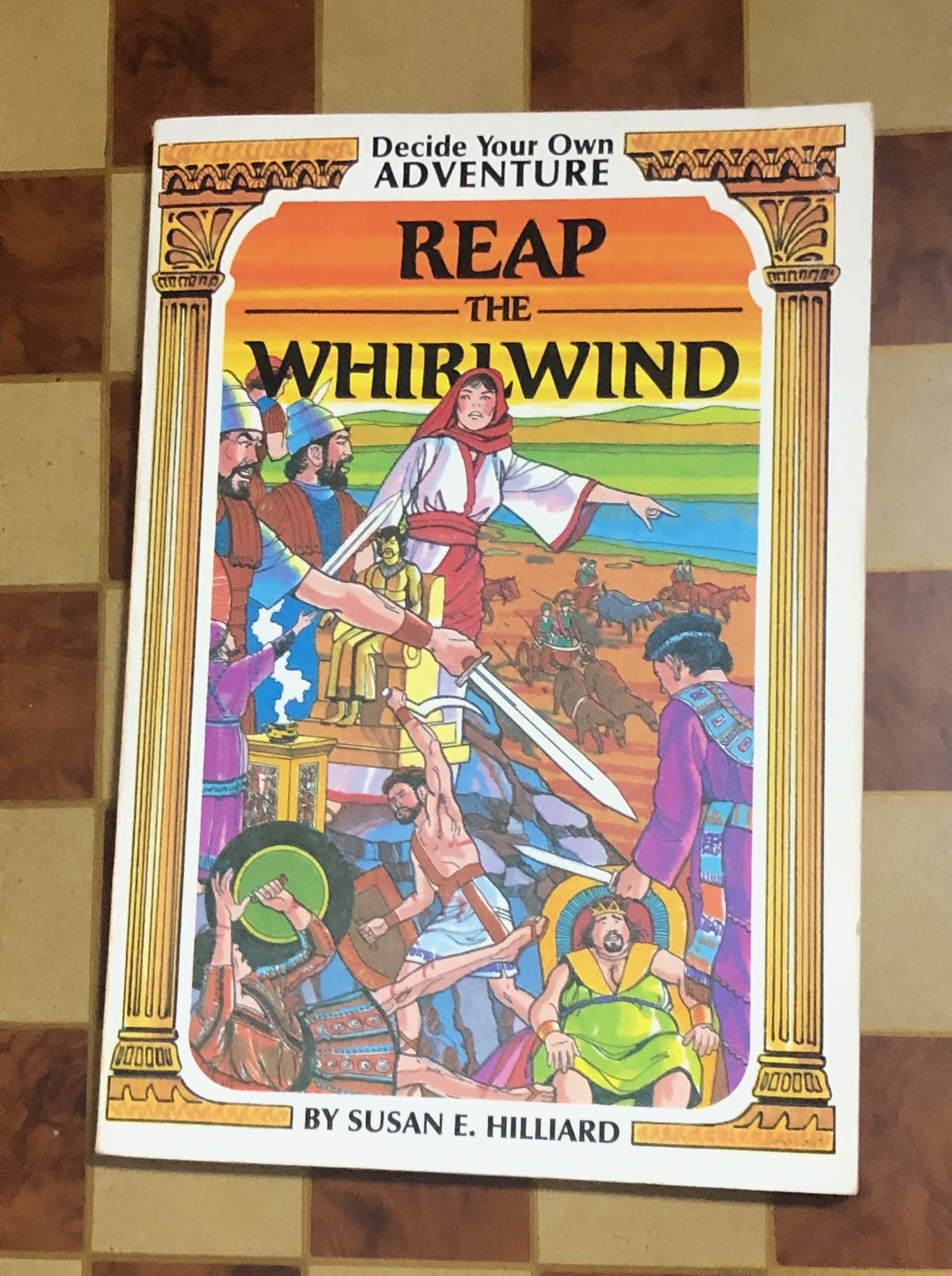
For those of you just tuning in, these books are Bible-themed gamebooks that cover different topics from Bible stories.
Wait. Don’t leave yet. It gets better, I promise.
Still with me? Good. Despite being aimed at younger readers, they do a commendable job of minimizing censorship of the less pleasant details of those stories, and O Lordy is this one no exception! Also, despite the lack of player agency, the books are fairly well-written and do a good job of making these stories more engaging, even if interaction is limited.
Also-also, the artwork is stellar.
Quick summary of the premise: we’re some random kid who gets chosen by a fiery talking ghost horse to travel back in time and learn things about people who lived in Ol’ Bibley Times. We are not allowed to influence or otherwise change the course of history, as our mission is one of enlightenment, not action or adventure…which is easier said than done, as we are always dropped right in the middle of the action and put directly in harm’s way by said ghost horse, who never seems all that concerned about leaving young kids to be potentially sold into slavery or poked with spears. At the end of most chapters, the ghost horse gives us a choice between different periods to travel to next, since we visit these events out of chronological order, and there’s a chance we will miss out on something depending on the path we choose through the space-time-bible continuum.
Personally I still would rather have the option to change the outcome of these stories for the worse, and have my Bible knowledge help me to make the right decision. The editors at Standard Publishing circa 1990 probably balked at that idea. What a shame.
In the previous volumes covered on this site, we focused on the exploits of and events surrounding a specific figure from the Bible (i.e. Joseph and Elijah respectively). This time we’re treated to an anthology of sorts rather than a single narrative about a single character, because our mission of the day is to observe the various holy judges of Israel, learn what happened to them (lots of things), why they were important (reminding everyone not to be materialistic), and whether or not the Israelites could ever finally learn to stop getting suckered by pagan tyrants (nope).
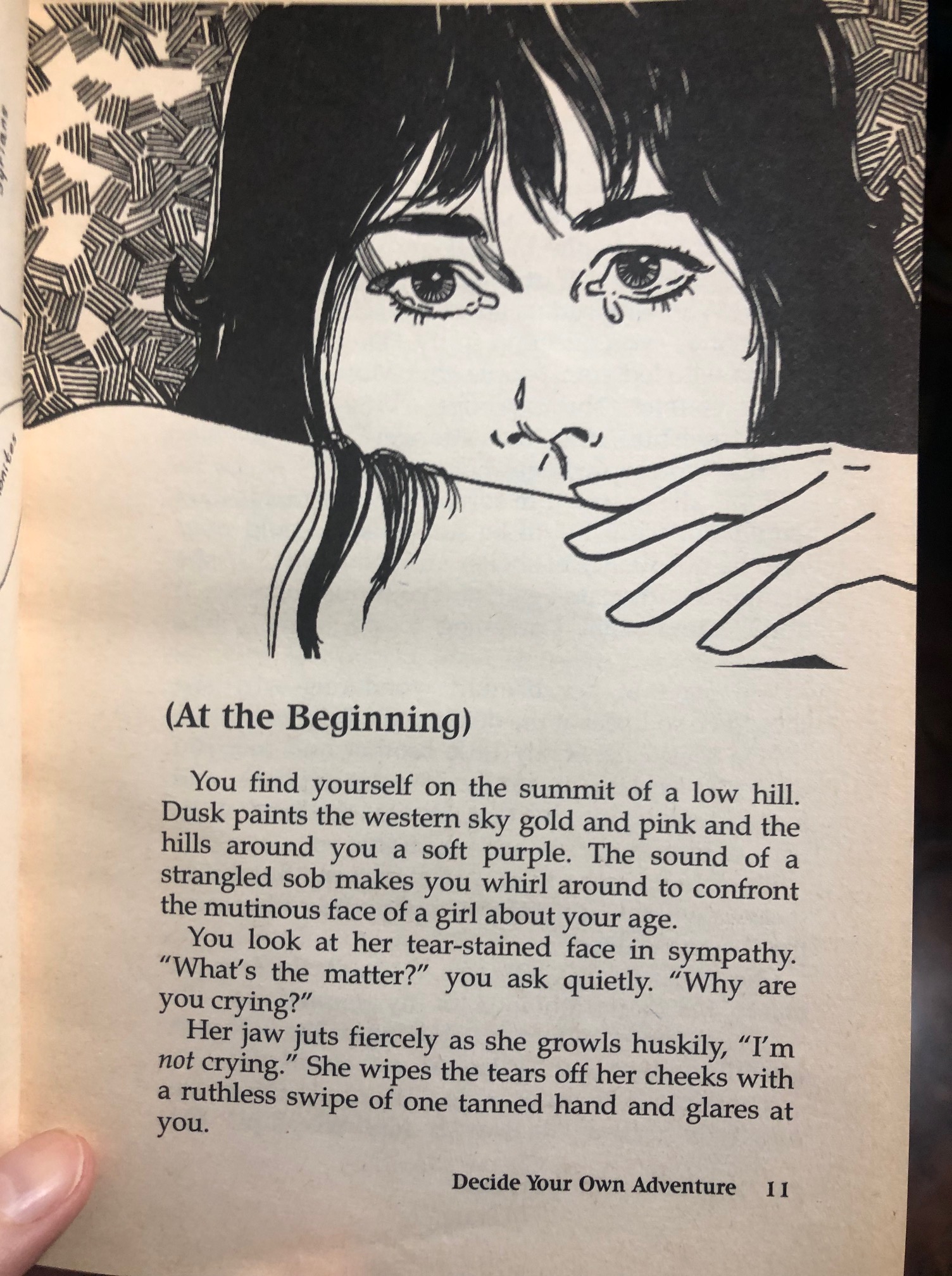
This one got off to a weak start, with a big exposition dump from a weepy girl, and at first I had little hope that it would turn into a worthwhile entry for the series. Fortunately the further I went, the more intense and exciting things got. I won’t spoil the details, but in a first for the series, things get so bad that our nameless protag actually tries to break the cardinal rule about not changing the timeline. The payoff was weak, but it was fun while it lasted.
DYOA goes into pretty dark territory here. We’ve got baby sacrifices, temples of ill repute, drunken debauchery…and murder. Boy oh boy, do we gots murder. All kindsa murder. We got large-scale battles, we got stabbings, we got tyrants getting shishkebabbed by giddy women. I thought for sure they would censor what happened to poor Samson during his episode, but not only does our nameless hero get sick to his stomach from the eye-gouging, there’s even a graphic illustration to go with it!
I decided not to share that one. Instead, here’s a two-page spread of a man with a tent stake driven through his skull.
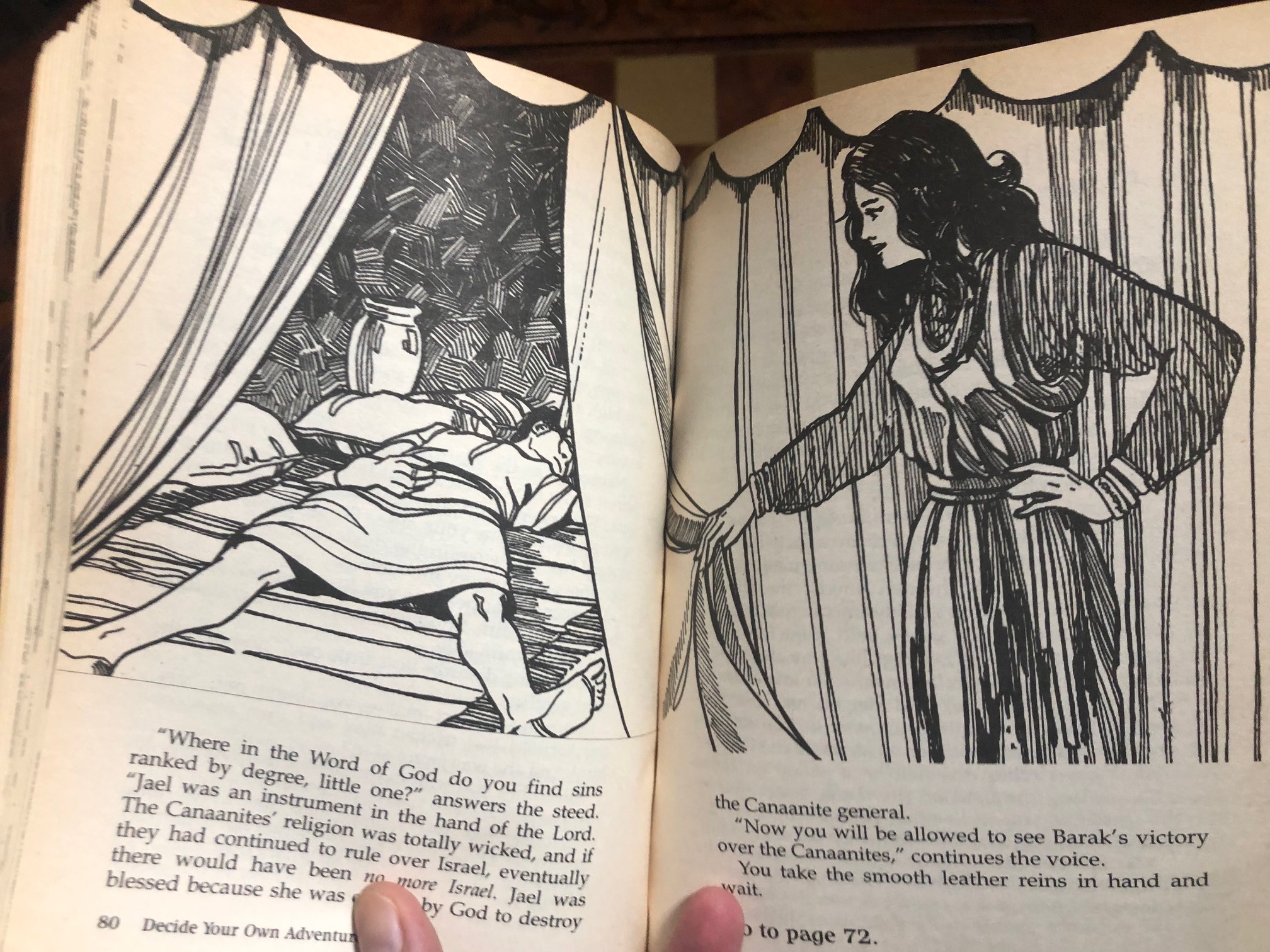
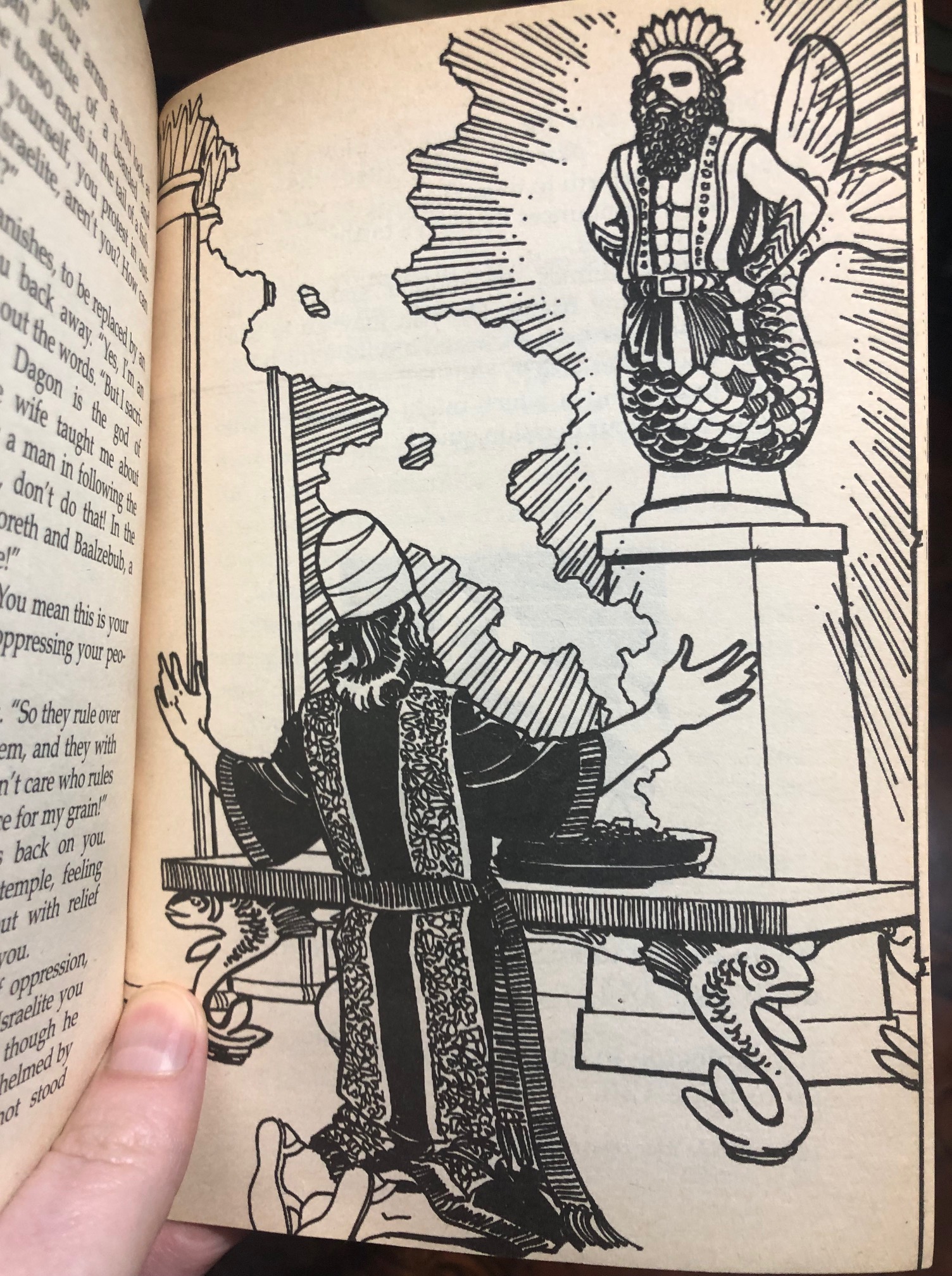
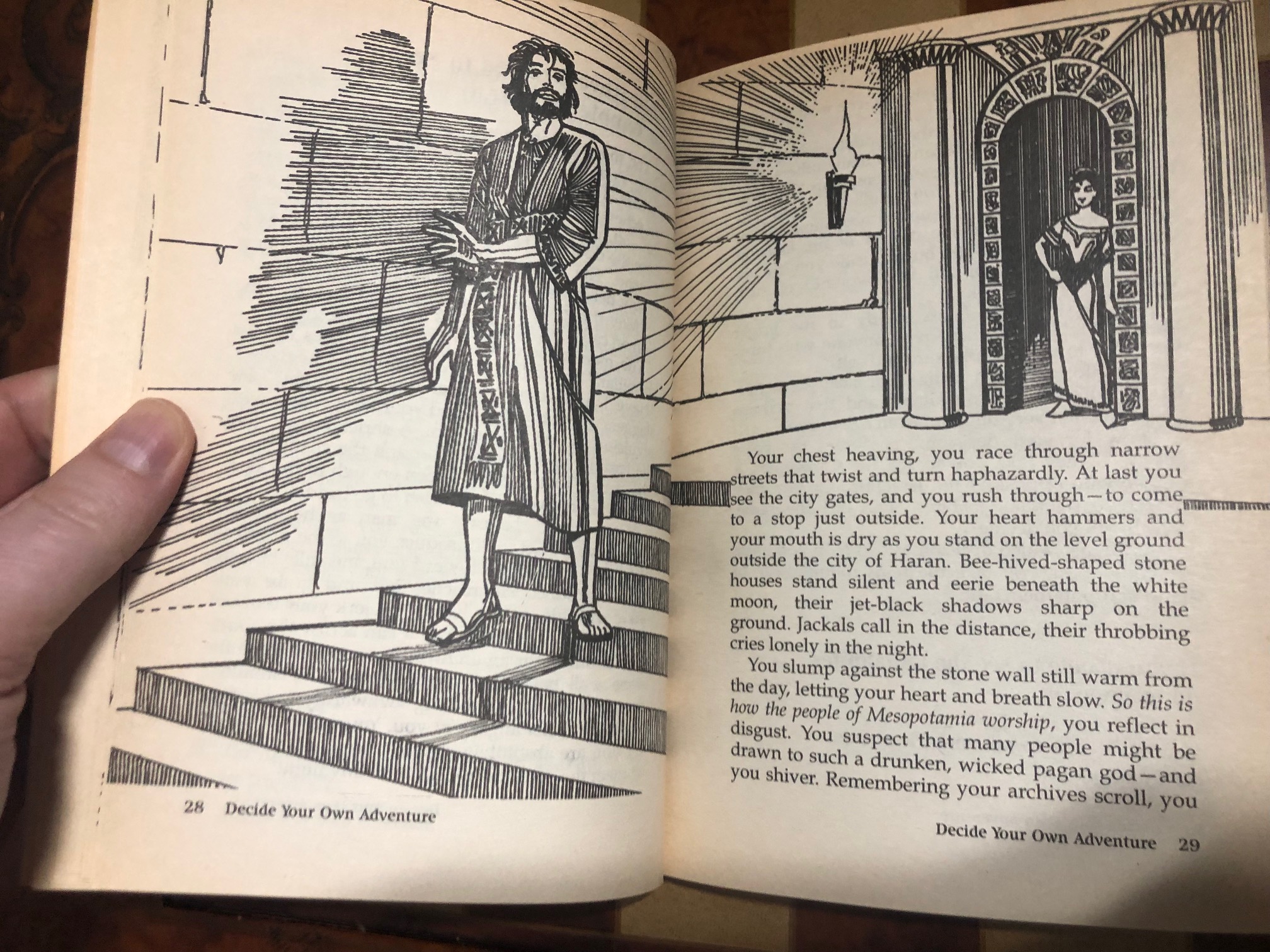
My favorite moments in these books are the ones where you peek in on the daily life of the heathen folk. They seem perfectly nice and normal when you first meet them, and then as you’re passing the butter across the table, your hostess casually asks her husband,
“Did you remember to sacrifice our first born son to Dagon on your way home from the store today?”
“No. I was gonna, but…”
“You STILL haven’t sacrificed our son?! Do you WANT us to be poor?!”
“I’ll do it first thing in the morning! Quit nagging!”
It also has the usual DYOA pitfalls, though, possibly due to the author’s word count being limited by the publisher. I went 300 years into the future to see if Israel finally learned its lesson after all the judges’ hard work and sacrifice, only to be briefly told by a roadside beggar in a hurricane that nope, they sure didn’t. Then I’m whisked away to another period as quickly as I arrived.
I mean, how do I know this dude was even telling the truth? I didn’t see any misery or oppression in that period. I just got lectured by a soggy dope in the wilderness. He could be the town doomsday monger for all I know! He probably started ranting about the Second Ice Age as soon as I left!
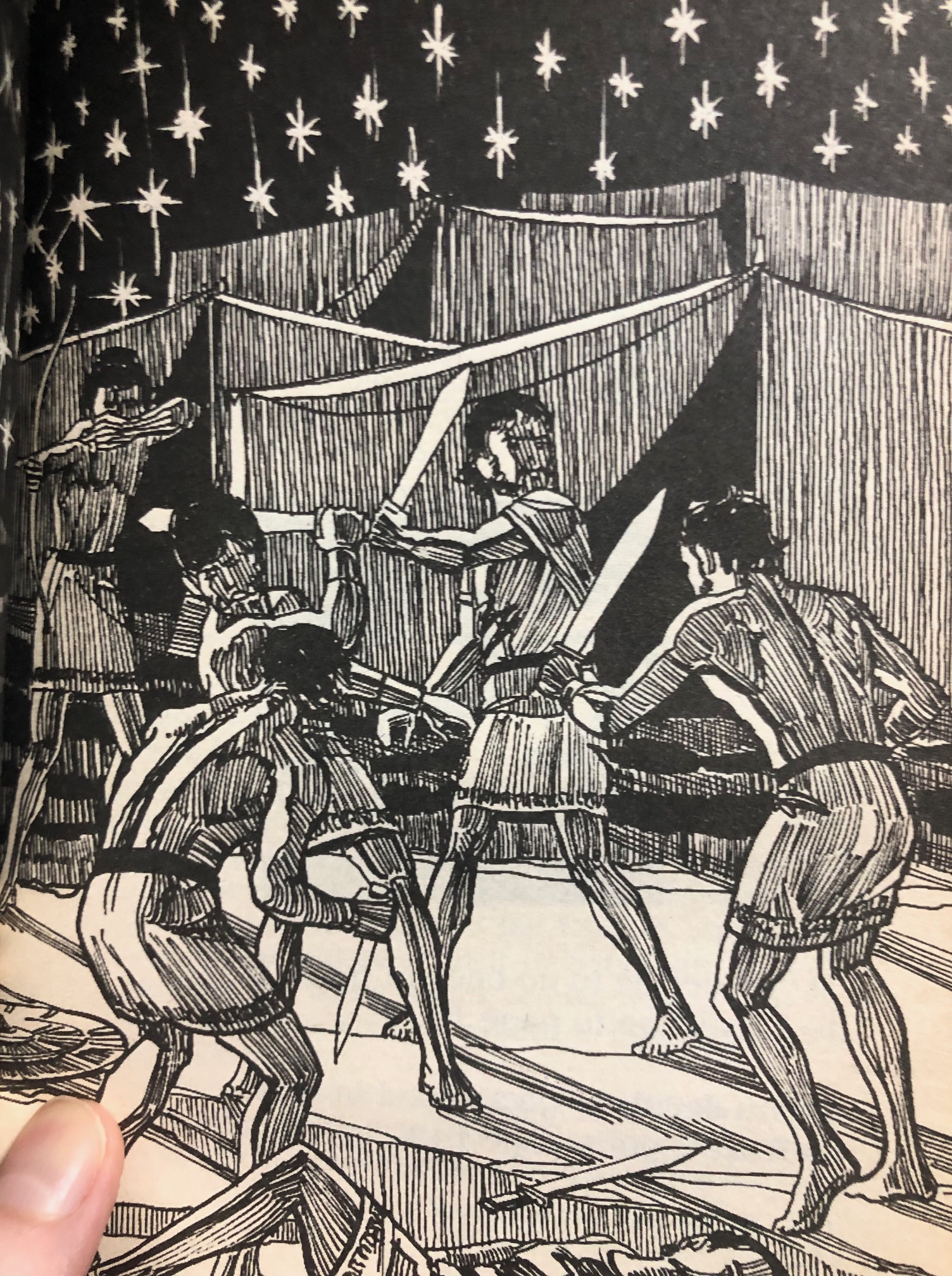
The variety doesn’t just come from the different protagonists, either. Sure, you get a moody revolutionary type, and a holy woman, and Christian Hercules all in one book. But I was pleased to find that despite so many episodes revolving around oppression of the Israelites, the oppression could come in different forms. One nation rules by fear, threatening to march their troops all over their faces just for being too poor to pay tribute in gold rather than goats. Another is friendly with the Israelites, having gone with the corrupting “cult of personality” approach, to make them happily join their side and forget about all this mushy God stuff. Who needs piety when you can have Kentucky Fried Infant?
Also there’s the usual disappointment of picking between Choice A and B, only to visit both choices back-to-back anyway, rendering the choice moot. This sort of thing could easily be remedied if the author had allowed us to change the course of the story. What better way to learn about the importance of an event than by letting us prevent it from happening at the future’s expense?
I know, I keep bringing it up, but this is my biggest gripe with the series as a whole: that we’re limited to observing events and learning from them. It’s a fun way for a young reader to learn about the Bible, but it would have been even better if there had been less emphasis on education and more on entertainment. Bringing the two together has always been a mystery to religious groups.
Reap the Whirlwind starts off weak, but builds a lot of steam once it gets going, so I can’t really fault it too much. The fact that we’re treated to several mini-episodes is a nice touch, too, and it isn’t lacking for action and intrigue. Grab this one if you’re into these books, or if you just want to check out a Bible-themed CYOA on a lark. Unless dead babies and eye-gougings makes you queasy.
Time for bed. Uncle Mac out.