“If I’m going to be eaten alive, I want to know why.”
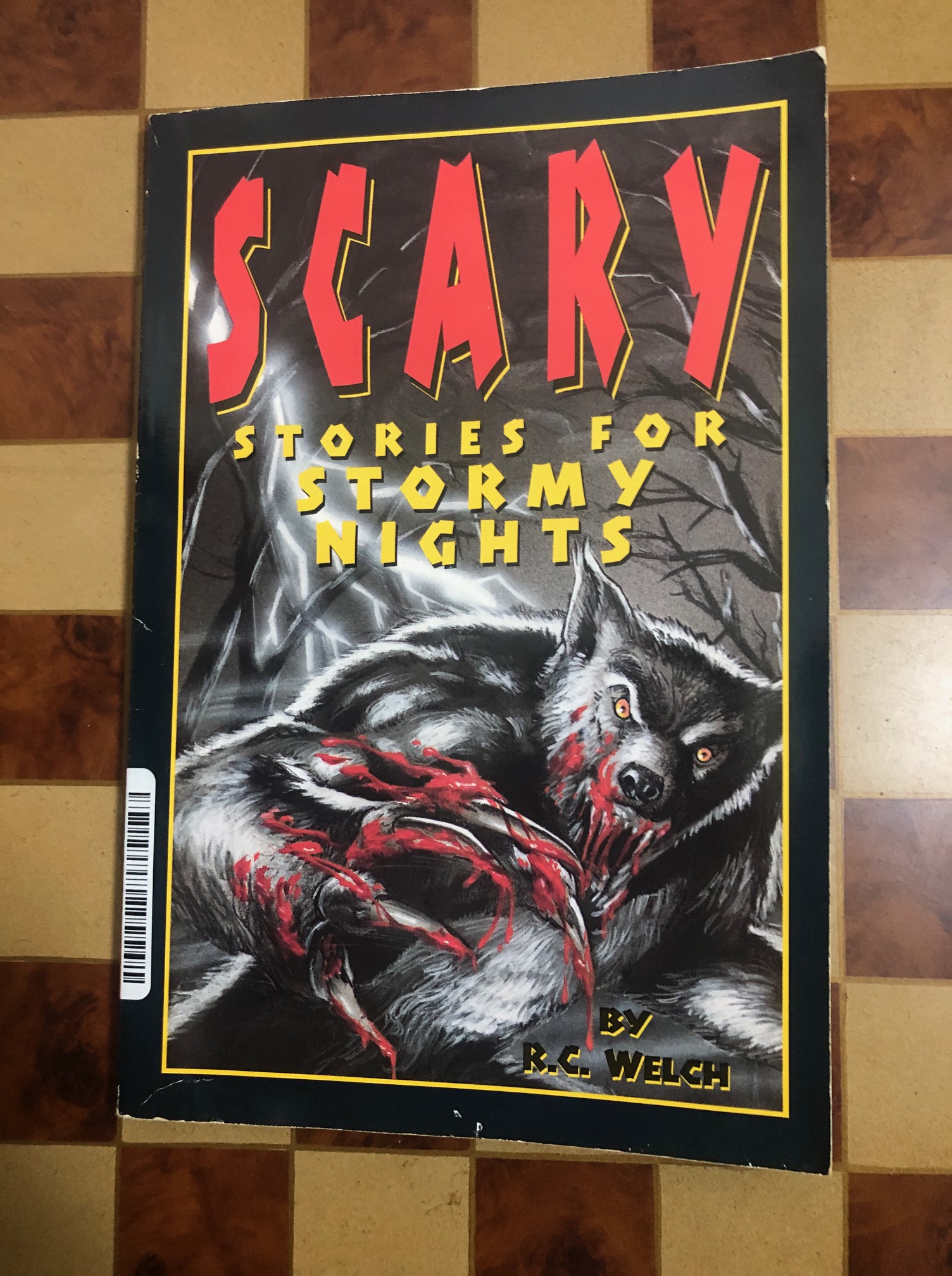
We’re taking a look at yet another anthology by one of our favorites, RC Welch, the YA horror author whose name sounds like a soda. There are a couple versions of this book, and I was lucky enough to snag the Parental Disapproval edition with the highly bloody cover image. Lookit that gory werewoof! He’s so mean and scary!
Previously we covered Welch’s first and only Scary Stories for Sleepovers volume, and the two Twisted Tales books he authored. Sleepovers still holds the title as the best anthology in my view, with stories that carry a similar flavor to Tales from the Crypt or The Twilight Zone: weird, spooky yarns that usually end with an appropriate twist. Twisted Tales by contrast went the Junji Ito route, focusing more on shocking scares and disturbing imagery.
The theme of Scary Stories for Stormy Nights appears to be folklore and the outdoors. Every story involves camping, mythical beasties, or both. The stories in this collection don’t stand out to me nearly as much as those in Sleepovers or Twisted Tales, but there are a few honorable mentions here. For the most part these tales feel like the “B reel” of those anthologies: certainly dark and moody, as all of Welch’s work is, but without leaving a lasting impression.
Of course, I read this book as an adult, and some of these yarns might have stood out to me more if I’d first read them as a kid. But I can’t see myself coming back to revisit this one years later like I did with Sleepovers, or would undoubtedly have with Twisted Tales. There’s a certain lack of “oomph” with Stormy Nights, like Welch was running out of steam in the Young Horror genre.
Doesn’t mean there’s no gold in them thar spooky hills, though. Even Welch’s weakest works are oozing spooky atmosphere and tension, and if nothing else his body of work is a great source of inspiration for young would-be authors of chillers and thrillers. He always plants you right there in the action as he builds up to the payoff, and sometimes the payoff itself pales in comparison to the trip we took getting there. He transports us like a magician to spooky swamps and sweltering deserts and eerie attics. Most importantly, he never breaks the fourth wall or lessens the horror impact with a dumb joke like RL Stine: he plays most of these stories straight, and the endings usually strive to be grim and chilling, unless the intent is to make us laugh.
Well, with one exception in this case.
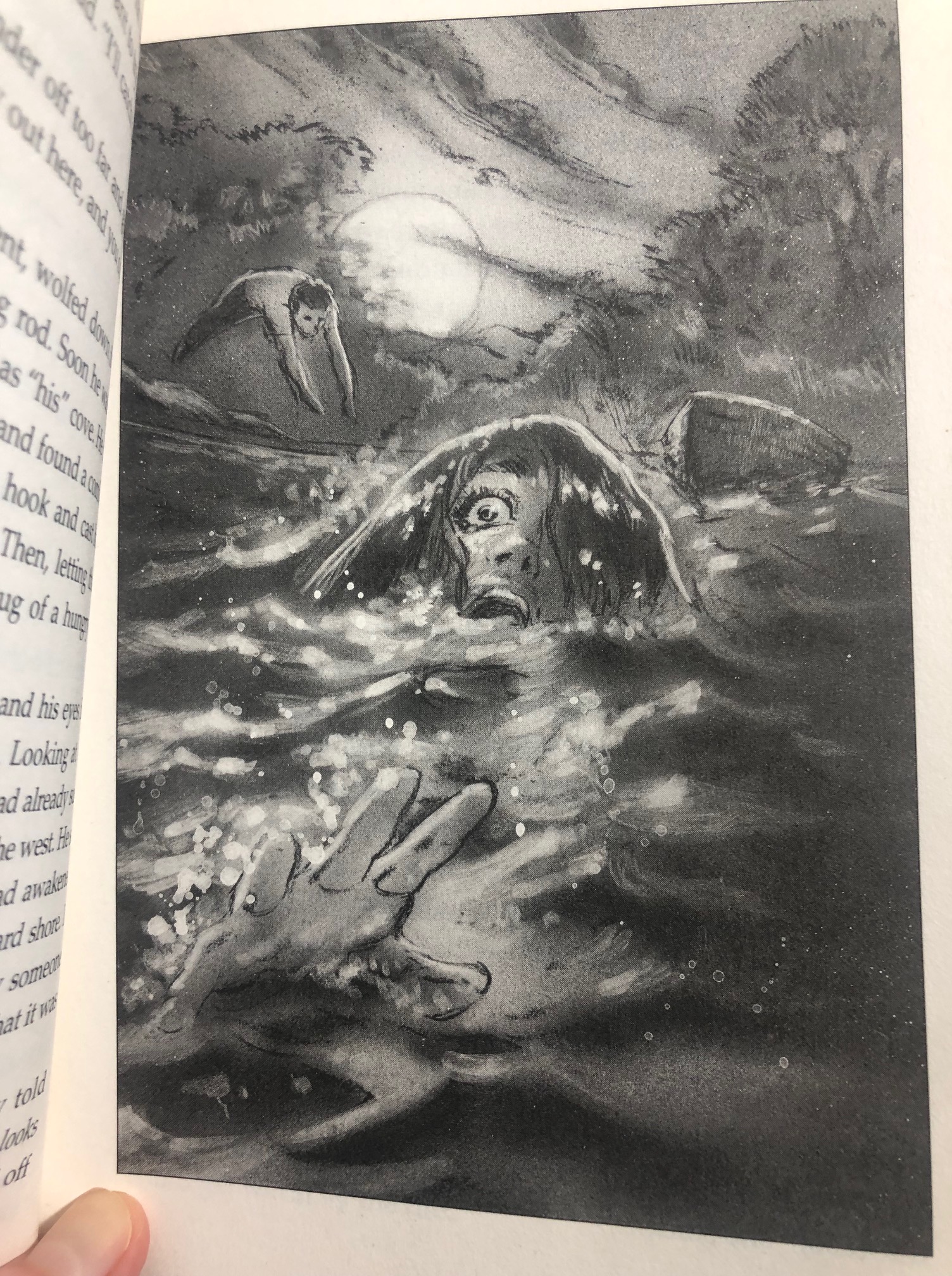


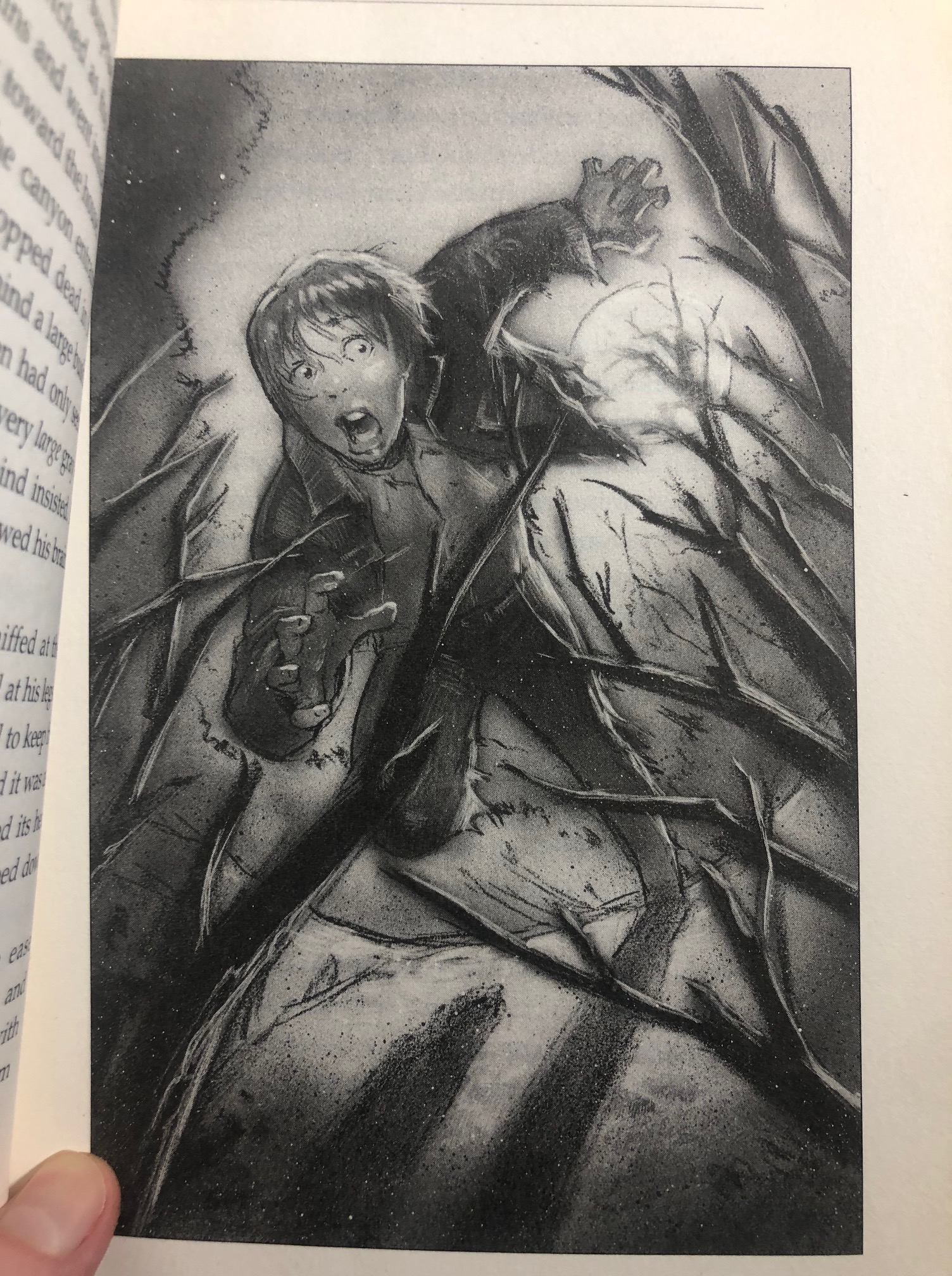
And can I just say how stunning the illustrations by Bernard Custodio are? If only these stories had been in comic format with Custodio as the artist, it would have made such a huge difference in the book’s overall impact. The panic in the drowning girl’s face burns into your memory. The zombified look of the mother watering the ravenous plants in the foreground, the frantic horror of the girls being set upon by mosquitos, even the poor dumb kid stranded in the desert–they’re all so striking and full of personality and dread. Every one of the images in this book is worthy of a picture frame and a space on your wall.
As reading material, I’d say Scary Stories for Stormy Nights is…okay. If you’re a young reader with a spook itch to scratch, and you’ve read the other anthologies already, give this one a go. You’ll find a few scares in here for sure. As far as the dope artwork goes, it’s a must-have.

Now comes the nostalgic portion of our retrospective, where I summarize each story for those who want a trip down memory lane, add my two cents, and try to figure out the moral of the story. If you haven’t read this anthology yet, go get a copy and read it for yourself first, then come back here and let me know if you agree or disagree with any of my assessments. I love a good dialogue about the writing process.
~
THE SHAPE OF THINGS
SUMMARY: Glen, his family, and his German shepherd Dolph just relocated to a new house out in the boonies on the edge of town, with plenty of forest and hills to explore on the weekends. While exploring a ravine one day, he comes upon the ruins of an old cabin that Dolph refuses to follow him into: the faithful dog seems to dread the place, but Glen blames the fearful stink of a large animal that had apparently visited the ruins recently. Shortly afterward he witnesses an old man enter the cabin, and a giant wolf come out and give pursuit. Dolph sacrifices himself to protect his cowardly owner, who flees into the night.
Later Glen sees a news report about a man found mauled to death in the woods, and thinks it’s the old man he saw previously. Glen convinces his friend Brandon to go scouting for the wolf, wracked with guilt over leaving his dog to die the night before. They soon find the remains of Dolph, and while Glen is overcome with another guilt attack, Brandon leads him into the ruins of the old house, where five people are waiting like a jury. Brandon reveals that he and the others are werewolves, and the dead man on the news was indeed the wolf that attacked Glen: Dolph killed the beast protecting Glen, so the other werewolves killed Dolph, and now they want Glen to repent for the loss of their brethren by drinking a weird potion. Assuming he will join them as a replacement, Glen has no other choice but to oblige…and is turned into a fat, juicy rabbit for dinner.
MY THOUGHTS: This one is kind of a weak opening to the book, which is a common trend for these kinds of anthologies, it seems. The story stops making sense partway through: Glen’s desire to explore the woods and valleys is believable enough, but his quest to track down the wolf by himself is absurd. He’s a kid, not a seasoned hunter.
The story does get some bonus points, though, for the unexpected ending. The whole thing was pretty bland and unremarkable throughout, and I thought it would end on a similar note, with Glen joining the pack. That he was turned into a symbolic sacrifice–and a scared rabbit, no less–is poetic. Not enough to save the story, but it makes up for it a little anyway.
MORAL: Guilt kills. So do guns, which you should always bring with you when you leave the house.
~
BLOODY LAUNDRY
SUMMARY: Ellen, Cybil, and Nola brave a rainstorm on the long walk through the woods to school, wishing they’d had their parents drive them after all. As they come to a bridge over the river, they spot an eerie woman washing bloody laundry in the river water who doesn’t seem to notice them, even when they scream in horror and flee past her. When they arrive at school, they start to have doubts about what they saw, until the PE teacher’s daughter Erin hears about the encounter. She says they’ve just encountered a Bean-nighe, a celtic spirit of a woman who died giving birth, who is now doomed to wash her bloody laundry until the day she would have died naturally. The spirit itself is harmless…except that anyone who sees one is doomed to die.
The girls write off the legend as nonsense, but can’t stop entertaining the idea of the death curse. Did the encounter mean that one of them will die, or all three? They soon find out the hard way when Cybil’s body is pulled out of the river from an accidental drowning, and Nola chokes to death during a neighborhood blackout. With the telephones out, Ellen braves the heavy rain and runs back home to find help, developing a nasty cough along the way. When she arrives home, she finds the house empty, and decides to take some cough medicine while she thinks of what to do. Unfortunately, in the pitch darkness, she accidentally drinks her mother’s hair dye, and poisons herself. Whoops.
MY THOUGHTS: A pretty good premise. The monster itself only makes a brief appearance, and doesn’t actually do anything wrong. Of course, it doesn’t have to do anything wrong: the awful celtic luck of seeing the thing is enough to doom you to a tragic fate, and nothing you do can prevent it. Some of the deaths are a little silly, but they make sense in the context of the story, and the backdrop of the heavy rainstorm really sets the mood. I liked how this one played out. The monster isn’t nearly as scary as anticipating your own idiotic death.
Ellen’s final thoughts including the phrase, “Yeah, right!” was a bit of a downer, though. It’s Stine-esque and kills the mood of a story not meant to be funny.
MORAL: Ride with Mom and Dad next time.
~
THE GOOD DEED
SUMMARY: Cory is bored going on camping trips with his mom, dad, and two pesky sisters. He’s about to enter junior high, and the cool junior high kids camp on their own, apparently. Since Cory hasn’t been to this particular lake before, he decides to explore the shore by himself, and discovers a private little bay on the far end of the lake, and a path leading to an old cabin in the woods. Unlike the hero from two stories ago, he’s smart enough not to explore that alone and heads back to home base. He comes back later to do some fishing in the bay by himself, and ends up saving a girl from drowning after she falls out of her raft.
As thanks, the girl takes Cory to dry off in her grandpa’s cabin in the woods, and Gramps is instantly mistrusting of the boy. The old man is horrified to learn about how Cory rescued her from drowning, and suddenly bars the door and tells Cory about the shape-shifting nixies, water spirits who drown people, and get very angry when their prey is snatched away from them. Cory briefly suspects that the girl he rescued is actually a nixie who already drowned the granddaughter, but then the real nixie comes slithering under the door to get Cory for stealing its kill.
MY THOUGHTS: It’s a shame that one of the best illustrations in the book got one of the weakest stories. There’s a whole lot of nothing going on besides the brief intrigue of the weird cabin. The idea that the girl was really dead and being impersonated by a nixie was predictable, but still better than the monster literally walking up on the cabin and knocking angrily on the door. If I’d written this one, I’d have begged the publisher to give me more time to iron it out and make it better. A predictable ending is better than a weak one.
MORAL: Learn to swim. Then don’t do it alone.
~
SOS
SUMMARY: Gina is on a four-week yachting expedition with her mom and dad on their ship, the Penny Dreadful, which they intend to spend exploring a series of tropical vacation spots and small islands. At one stop, a fellow yachter named Carl regales Gina with all kinds of stories about his adventures at sea: exploring the islands, evading real life pirates, and learning about weird folk tales, like the one about the ghost slave ship that sank with a booty of child slaves aboard.
After they set sail again, the family realizes an ominous ship in the distance has been tailing them. The parents try to pretend it’s no big deal, but Gina knows better, because she can tell that they’re scared, and she’s been eavesdropping on their hushed conversations about the ship gaining on them every day. The family becomes increasingly worried that pirates have marked them for murdering and plundering, and no matter what Dad does, the Penny Dreadful can’t outrun them. Only when the ship bears down on their little yacht does Gina finally realize that it’s the spectral child slave ship of legend, come to add her to its cargo. A volley of cannon fire wrecks the yacht and leaves Gina screaming at her dead parents, and as the undead crewmen drag her aboard, she gets a glimpse of her own dead body floating among the wreckage.
MY THOUGHTS: A good exercise in tension. Even when you suspect it’s a ghost ship and not pirates, which becomes fairly obvious early on, the dread of the distant ship closing in on the frightened family is pretty great. I don’t think the double-whammy ending works, though: Gina being dragged aboard and also realizing she’s actually dead. Whether dead or alive, her fate would be unpleasant, so the final reveal is irrelevant. It would’ve been more effective if she’d been defiant to the last, thinking they only took dead children, before finally realizing that she was indeed dead after all.
The skeletal pirate captain is a bit cartoonish as well, and the artwork doesn’t help. It’s the biggest downer of this story, turning an otherwise tension-rich tale into the Garfield Halloween Special. But the buildup is pretty great and I can’t fault it too much, I guess. Neither will young readers, I suspect.
MORAL: Don’t get on the boat.
~
ONE HOT NIGHT
SUMMARY: Dullard scout leader Mr Stone makes it very clear to Scout Troop 391 that there will be no campfires on this excursion, which bums out borderline pyromaniac Lee to no end. When he runs into a couple of kids from a camp over the hills collecting firewood for a bonfire, he becomes insanely jealous, and leaps at the invitation to join them later that night. Lee invites his two idiot friends to sneak out of camp when everyone is asleep and go party with the cool kids at the other camp.
While traipsing up the woodland hill, following the glow of the bonfire on the other side, one of Lee’s friends twists his ankle and can’t continue. Lee tells his other friend to hang tight with him while he goes over the hill to see what the party is like, then he’ll return and help carry the poor sucker back to camp. When Lee gets there, the camp turns out to be a fiery cult ritual, and the two kids he met before are elated that he showed up…because now they have a human sacrifice to throw into their highly flammable wicker man!
MY THOUGHTS: A very weak Wicker Man reference, if anything. I’d put it on par with “The Good Deed” as far as quality, which isn’t saying much. I’m glad Lee was such a self-serving, naysaying brat, though, because it at least made his comeuppance appropriate. What kind of jerk ditches his injured friend in the woods just to go check out a hootenanny?
Part of the issue is there’s no real buildup suggesting that the other kids are really up to no good. The story retains its message about not sneaking off to be selfish at the risk of your own well-being, but it would be more effective if the kids from the other camp had more to do to at least trick us into thinking they’re harmless.
MORAL: Never say, “I’ll be right back.”
~
GREENHOUSE EFFECT
SUMMARY: Hally is mostly friends with Natalie out of pity, since Natalie is the school weirdo and nobody likes her. She’s always on about some strangeness or other. Today she’s convinced she saw her mother’s doppelganger on TV, but her mother insists she’s been home in her greenhouse. Over the course of the week Natalie becomes increasingly convinced that her mother is an impostor who spends too much time in her garden with her new plants. She thinks the plants have replaced or otherwise influenced her mother, but Hally believes the strange girl has finally gone off the deep end.
Hally becomes worried enough about Natalie that she goes to her house to speak with her mother about her mental health, and does indeed note that Mom’s skin looks a bit greener. She spills the beans about Natalie’s paranoia, but Mom laughs it off and invites Hally into the greenhouse to talk some sense into Natalie. That’s where Hally finds the plants devouring Natalie in preparation for growing the new and improved Natalie, and Hally is added to the garden before she can flee.
MY THOUGHTS: The buildup in this one is confusing. I’m not sure if Natalie’s mom was the one she saw on TV while her evil double was at home, or vice-versa, and it’s never clearly explained. I like that Natalie is the school nutjob and thus nobody would believe her ridiculous claims in a million years, so the story kind of revolves around the idea that she’s spiraling into paranoid schizophrenia. If it had played off of that angle a lot more, and really run the mental health thing into the ground, the payoff would have been great. It’s still pretty shocking as-is: the image of Natalie’s dead husk with all the roots slithering in and out of it. The illustration to this story is one of my favorites: the mom’s thousand-yard stare is priceless.
Like many of Welch’s weaker stories, it has a lot of potential that just isn’t fully realized. Maybe publication deadlines are the culprit.
MORAL: Just because it’s a conspiracy theory, doesn’t make it wrong.
~
A “TRUE” STORY
SUMMARY: While his class is camping in the Colorado Rockies for a school field trip, Mark elects to tell the evening’s campfire story, which he insists is a true story he once heard. He tells about a boy who spotted a shooting star that landed near his neighborhood, and went off to examine the landing site, where he found a strange silver craft of alien origin. When the craft opened, a hideous tentacled thing dragged him into the ship and crawled inside him, taking control of the boy as he went around infecting other people, presumably with the intent to overtake humanity one neighborhood at a time.
The kids naturally disbelieve the story and ask how he could have heard it if the kid was possessed by an alien. Mark then reveals the story was about him, and as he opens his shirt, scores of tentacles spring out at the boys and send them running. Mark bursts into laughter, having rigged his shirt with spring-loaded nylon tentacles for the story’s payoff. Everyone laughs and admits it was a good trick, including Mark’s tentmate Kurt, who intently asks where he heard the story. When Mark admits he made it all up, Kurt says he’s glad, as he was afraid someone had found out about him being an alien. He then proceeds to eat Mark.
MY THOUGHTS: It’s fun. It really sets itself up for a predictable ending, and the prank payoff is funny and kind of clever. The reveal of Kurt’s alien nature punctuates the story perfectly. Probably one of the best in the anthology. Not a banger, but it’s cute and worth a chuckle.
MORAL: Never share a tent.
~
JUDGMENT DAY
SUMMARY: While Alex, Sarah, and John’s parents are getting drunk at a party up the road, the three kids are bored enough to bust out the ouija board from among the old western artifacts of Alex’s great grandpa (a former sheriff) and try talking to some spirits. They don’t really think it works, of course, but when they ask if there are any spirits present, the planchette seems to move on its own and its little glass window spells out utter nonsense. Alex insists it wasn’t him moving it, Sarah is spooked, and John is bored again, so they give up on the ouija board. But later Alex figures out that if he reads the letters highlighted by the tip of the planchette, rather than its little window, the phrase “AT LAST” had been spelled out!
Alex’s friends don’t want to hear about it, so he continues talking to the ghost alone, which claims it is lonely. As Alex communes with the spirit, its answers become more elaborate, and he learns that the ghost had lived in Great Gramps’s time and was murdered by the sheriff and seeks revenge so it can rest. Alex realizes too late that he’s brought back the ghost of a malevolent outlaw, and turns around to find the revenant standing right behind him, ready to take out his vengeance on the sheriff’s descendant.
MY THOUGHTS: This one’s really good. The mystery of the ouija board message sucks you right in, and the payoff with the revenant standing behind Alex in the dark is genuinely creepy. I kind of wish this one had enough room to be fleshed out more to maximize the spooks. One of my favorites from the collection hands down.
MORAL: Board games are for suckers.
~
BUGGED
SUMMARY: Stacy is fuming that her older brother Wade gets to go camping with friends without adult supervision, while she’s never allowed to do anything on her own. Her nerdy friend Fawn suggests asking her parents if they could go on their own camping trip, so long as Fawn’s older sister Mattie is there to supervise. The parents approve, but Stacy can’t think of any campsites besides the one Wade is going to, so they go there, to Wade’s chagrin. Once there, the girls are simultaneously terrorized by a hopeless amount of mosquitoes courtesy of the humidity, and an equally hopeless amount of mosquito factoids courtesy of Fawn. The mosquitos become so numerous and unbearable that the girls decide to abandon camp, while hoping Wade and his idiot friends are also getting eaten.
But as they hike back home, the mosquitos follow them: as Fawn points out, the bugs can smell their breath, their sweat, their everything, so there’s no escaping them. Eventually the little bugs swarm them in such numbers that they become stumbling, squealing pillars of hungry parasites, which swarm down Fawn’s throat when she opens her mouth to suggest a solution. Soon only Stacy remains alive, but only long enough to witness the colossal mother mosquito that spawned the little buggers, which has just finished feasting on Wade’s camp.
MY THOUGHTS: The mosquitos are never really a menace until late in the narrative, and it would’ve been nice if they’d done more weird and unusual stuff before the all-out assault on the girls. Granted, when they do lethally swarm them, it’s pretty horrifying, especially when they eat Fawn from the inside-out. The image of the giant mosquito at the end is surreal and nightmarish, and even though it’s absurd and comes out of left field, I kind of like it.
Not a great entry, but the dreary swamp setting and the ever-growing hordes of bugs is a nice, harrowing touch.
MORAL: Camping still sucks.
~
JUST DESERTS
SUMMARY: Evan wakes up at the scene of a plane crash, with both his parents dead, and nothing but endless desert all around him. When he finally recovers from the loss of his parents, he struggles to remember how he came to be stuck in this situation, but his concussion has scrambled his brains and made recollecting things difficult. He does remember where his late father stashed the emergency water packs, and sets out across the desert with a cache of supplies, hoping to find rescue or shelter.
Unfortunately, possibly owing to his concussion, Evan keeps circling back to the crash site no matter what he does, with his water–and his hope–steadily running out. As he wracks his brain to understand how he’s become trapped in his own personal hell, he finally remembers how the disaster began: Dad insisting on the family trip, and Evan throwing a hissy fit over not getting to go camping with his friends instead. Evan had been so resentful and bratty that he hadn’t bothered securing the fuel cap before takeoff, and they had crashed as a result of running out of fuel…a disaster that Evan must now pay for by dying in the desert.
MY THOUGHTS: Best in show. Welch really makes you feel trapped in the sweltering heat of the desert, and leaves you wondering whether Evan’s torment is due to his concussion or some kind of divine retribution. Stormy Nights definitely saves its best for last, as none of the other stories come close to being this well-realized. The shocking opener is incredibly strong, throwing us right into the aftermath of a violent plane crash, with one parent dead and another on death’s doorstep. Evan really gets put through the wringer, and when we realize at the end that he’s to blame for it all, it’s both gut-wrenching and satisfying. A+.
MORAL: Stop moping and do your job.
~

 Uncle Mac's Gamebook Shack