“Who knows what evil lurks in the hearts of men, and for that matter, women? The god Apollo knows!”
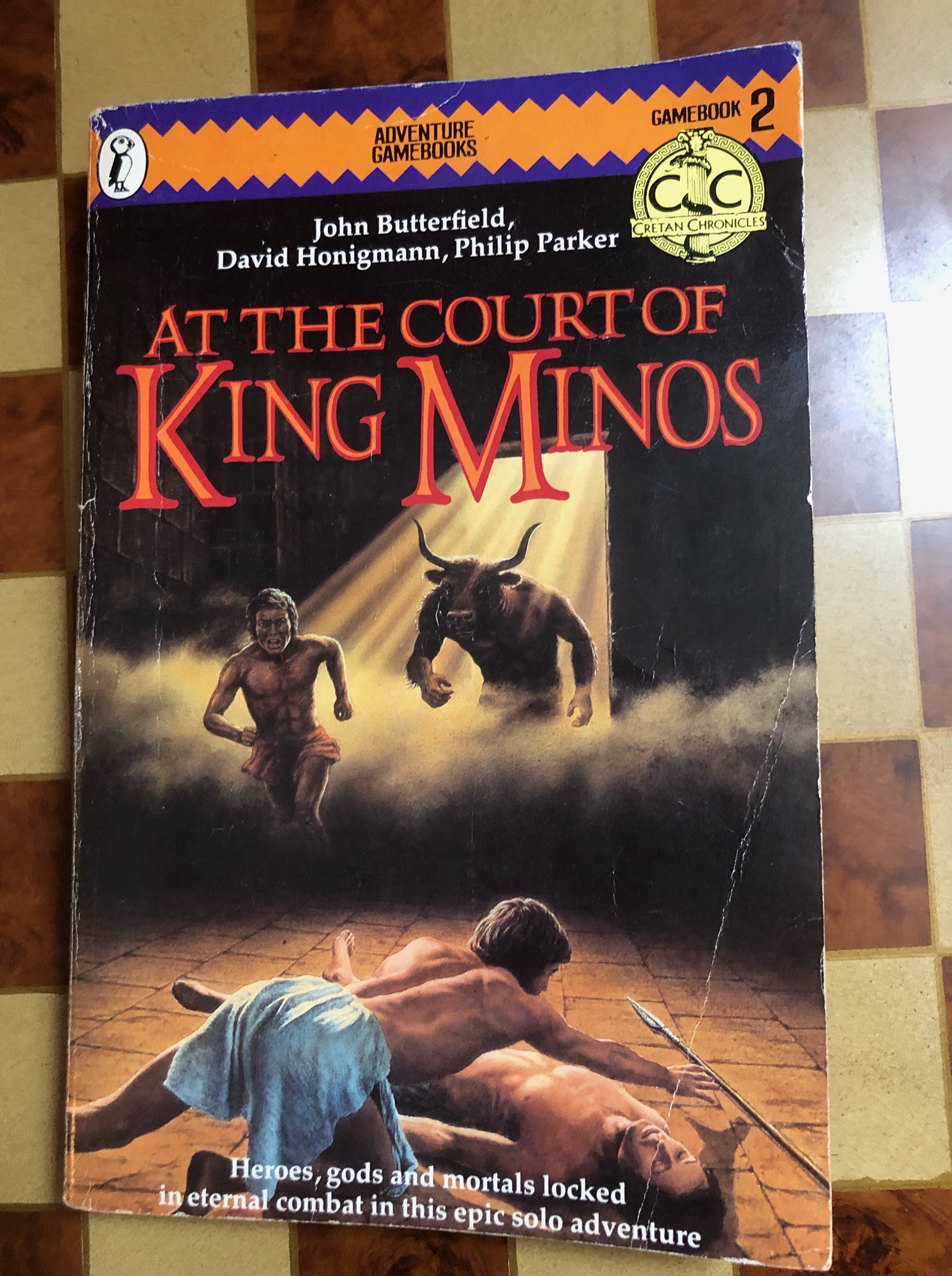
It’s surprising that the second Cretan Chronicles installment has a higher page count than the first, yet didn’t take me as long to complete. This probably owes to the combat-heavy nature of Bloodfeud of Altheus, which had me dying in fights all the time. By comparison, At the Court of King Minos is light on the fighting, and revolves a lot more around keeping your back to the wall in a royal court full of shady people.
As a quick recap, Cretan Chronicles is a solo RPG adventure in the vein of Fighting Fantasy, but with a refreshing ancient Greek setting. It is a trilogy of inter-connected books rather than an ongoing series of self-contained adventures, and everything you gained in the first book carries over to the later books. This sounds great in theory, but the trinity of authors behind this series have a bad habit of thrusting unpolished and insanely difficult design choices upon the reader, and even the carry-over concept wasn’t immune to their salty touch.
Still a cool book series though, don’t get me wrong.
At the Court of King Minos picks up where Bloodfeud left off, with Altheus’s arrival in Crete. His mission: kill the minotaur and avenge the death of his brother, Theseus.
Secondary mission: confront King Minos and renegotiate the rotten contract he forced Dad to sign, particularly the clause about sending a steady supply of young men and women to be fed to the minotaur.
As I said, everything you acquired in the first book carries over to this one, but if you haven’t read the first book, there are several quick-start options to get you caught up.

This is interesting because whichever patron god or goddess you choose in this early stage gives you a different recap of the first book based on that deity’s influence in your adventure. In some, you spared the Amazon queen and got the name of a useful contact in Crete, while in others you happily slew her and her entire city.
I should probably have gone with one of these quick-start options, because my first playthrough ended on a hilariously inept note. I hadn’t read the first book in a while, so when the chief guard came to lead the slaves from my ship to be sacrificed to the minotaur, I mistakenly assumed I was going with them, and decided to flee from the cops. Cue a short Benny Hill chase where every direction led to my being recaptured, thrown in prison, and tossed into the labyrinth to be devoured.
Three or four attempts later, when I finally decided to come quietly, it dawned on me that I wasn’t part of that miserable lot, I was actually supposed to be taken straight to Minos on business. D’oh.
I was disappointed, too, because my fight with the guards was the first fight I’d legitimately won in this series, having been forced to cheat to make it through the first volume thanks to Altheus having the combat durability of a water balloon. Remember when I had to fight the Marathon Bull with a stick and a trash can lid? Remember how it was mathematically impossible for me to land a hit on the beast? Yeah, now I have a holy sword, shield, and breastplate. I eat Cretan centurions for breakfast.
I go to jail a lot, too, for all my efforts. Nuts.
So I’m led to the court of King Minos at last. What follows is a lengthy game of intrigue as I chat with the members of Minos’s court and constantly second-guess who is a friend and who wants to knife me in the back. The story is engaging and I like getting to sneak around in restricted areas like James Bond in a sarong, so it was pretty fun. Every little choice on offer was seemingly mundane, yet turned out to be delicate and life-altering. I offered the official letters to Minos upon my arrival and got Shame points for not indulging his hospitality first.
In fact, I wasn’t sure if I still had the letters or not. That led to a number of embarrassing dead ends as well.
At least I was smart enough NOT to tell the maid assigned to pamper me that I’d come to kill the minotaur and avenge my murdered brother. Sure enough, if I spill my guts, she dresses me in colors that warn Minos I’m not to be trusted.
Politicking is tricky, man.

Eventually I’m one way or another corralled into a boxing match with Minos’s surviving non-cow-headed son, and I’m introduced to a unique combat system that, hilariously enough, is better than the system they force me to use in all my other fights. See, normally you have to use your Might to penetrate your target’s Protection in order to deal a wound. You can bring them from Healthy to Wounded to Seriously Wounded to Dead. In other words, everything–including Altheus himself–dies in three hits.
Assuming you can break through their Protection, which is always in double-digits, and always seems to be equal to or greater than your ability to hit anything.
But for this book, we get a new stat called Endurance, which starts at 30. My opponent in the boxing match, Kremton, starts at 50. He’s a beast in a fight and everyone expects him to twist me into a pretzel. He usually does.
How boxing works is, I decide if I’m going to take a swing at Kremton’s head, groin, or body, to deal 3, 2, or 1 points of Endurance damage respectively. Then I roll a die and consult a chart to see which body part he’s protecting. I can keep whittling down his Endurance until he guards the area I chose to attack, and then we switch and now he gets to pummel me until I successfully guard. If you’re lucky you can get in a long string of devastating blows before he even gets a turn to punch back!
Surviving this fight is much more doable than the normal combat system, and you can see why. It’s also more engaging than simply thwacking my stat against the enemy’s stat back and forth. And at several points leading up to this duel, I have a good chance of having my Endurance reduced prematurely, say from getting drunk the day before (in violation of their sacred rites to Demeter, I might add), or being poisoned by an assassin on the dance floor.

The immersion is top tier in this second volume, as with the first. Everywhere you go in Crete, you feel like you’re really there. The labyrinth is the obvious highlight, the climax of the story, and it’s a dark, spooky, miserable place. It does a decent job building tension as you wander through its halls, wondering when you’ll stumble into the minotaur and face your messy destiny.
The labyrinth itself is a pain to navigate when you finally get there. In fact, I’m pretty sure the labyrinth is the reason why this book is thicker than the first one: there must be a hundred paragraphs devoted to the murals on its twisting, winding corridors, each one depicting a scene from a classic Greek myth, and I assumed that if I followed them in chronological order they’d lead me to the minotaur, but all they did was take me in endless circles until I stumbled into him by accident.
There are a couple ways you encounter the minotaur in the labyrinth: the one where you find him, and the one where he finds you. I got the latter, and even though the fight is utterly impossible (I had to roll a 12 on a pair of six-sided dice to hit him at all), this encounter was the most frightening thing in the book.

You have the option of making a bee-line straight for the labyrinth, in fact…if you weren’t dumb like me and got arrested and thrown in with all the slaves. What’s frustrating about this, though, is you’ll stupidly drop into the labyrinth without your weapons if you take this path. Why would I sneak away from the party to infiltrate the labyrinth if I didn’t have my weapons with me?
So the combat itself is still pretty broken, but a few other issues make this book just about as annoying as the first. To start, you will need several items to survive the labyrinth before you get there, but finding them evokes the “needle in a haystack” metaphor. You have to circumnavigate all the intrigue and all the branching paths in many different ways before you stumble upon the items you need, if you ever find them at all.
This isn’t so bad in itself, but keep in mind that some of these things appear to include having the right godly patron. Is Apollo your patron? No? How about Dionysus? Does he like you at least? No?! Well, you’re dead, then. Unless Zeus is willing to bring you back.
Oh. He doesn’t feel like it today. Pity.
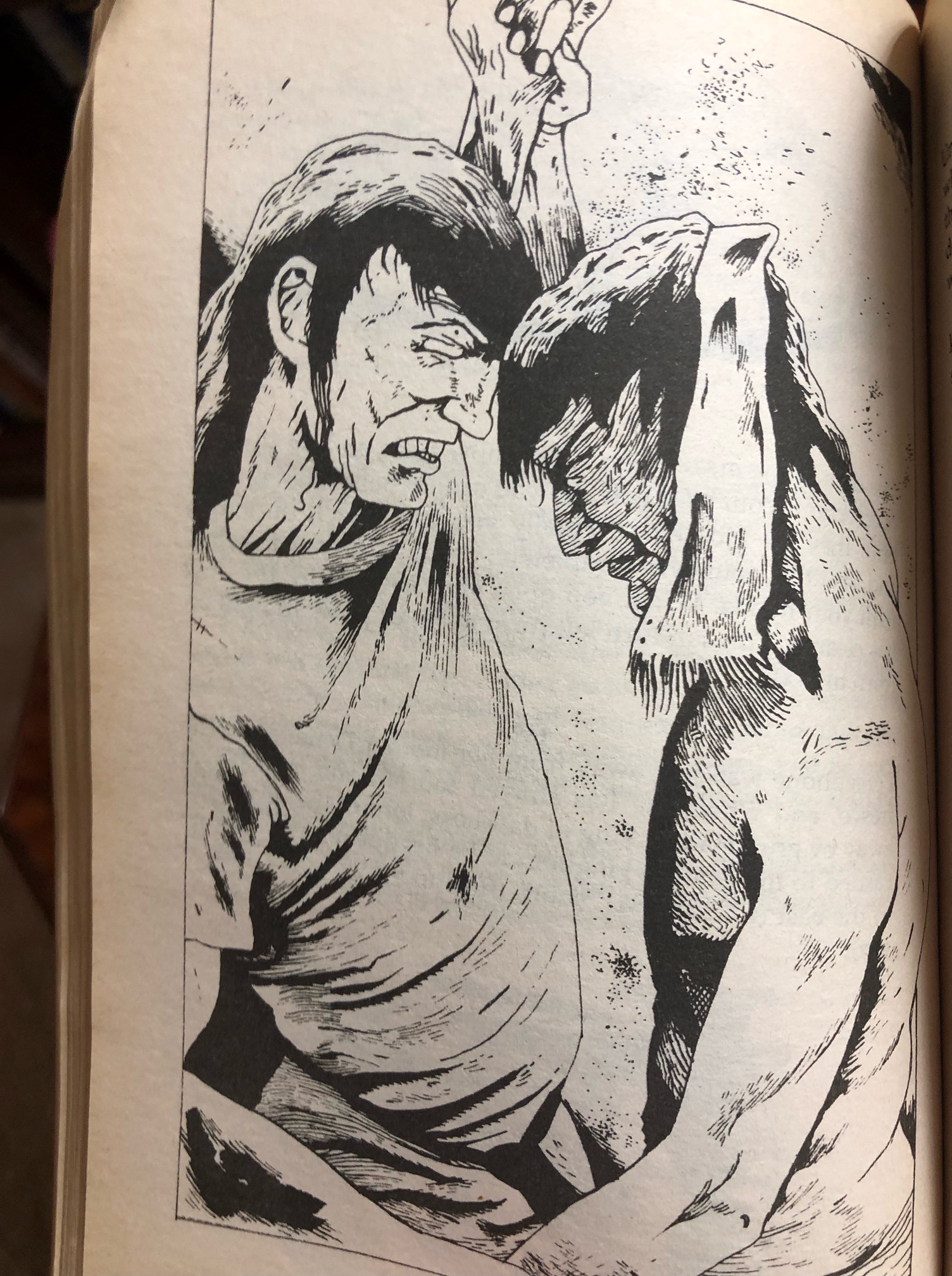
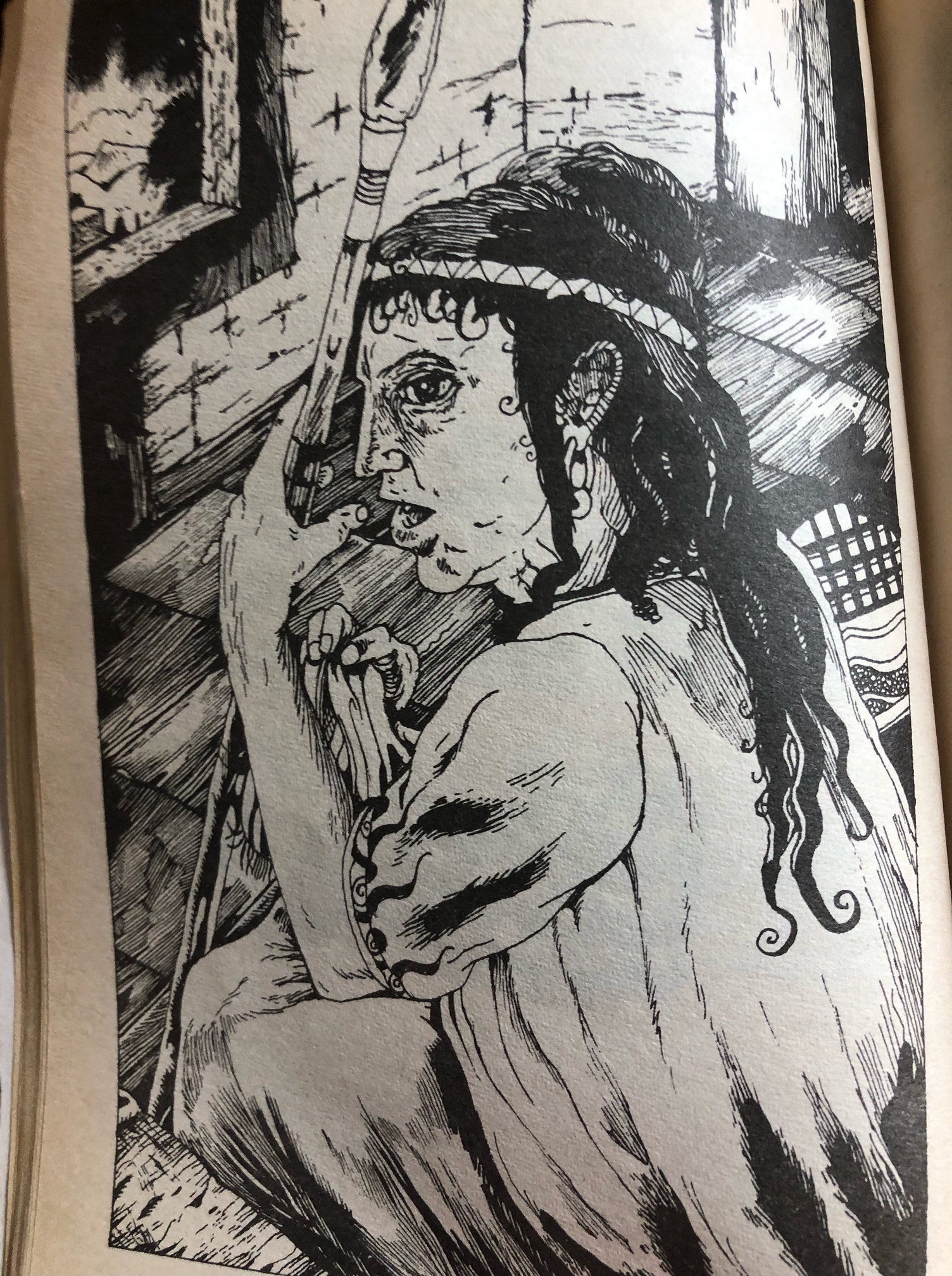
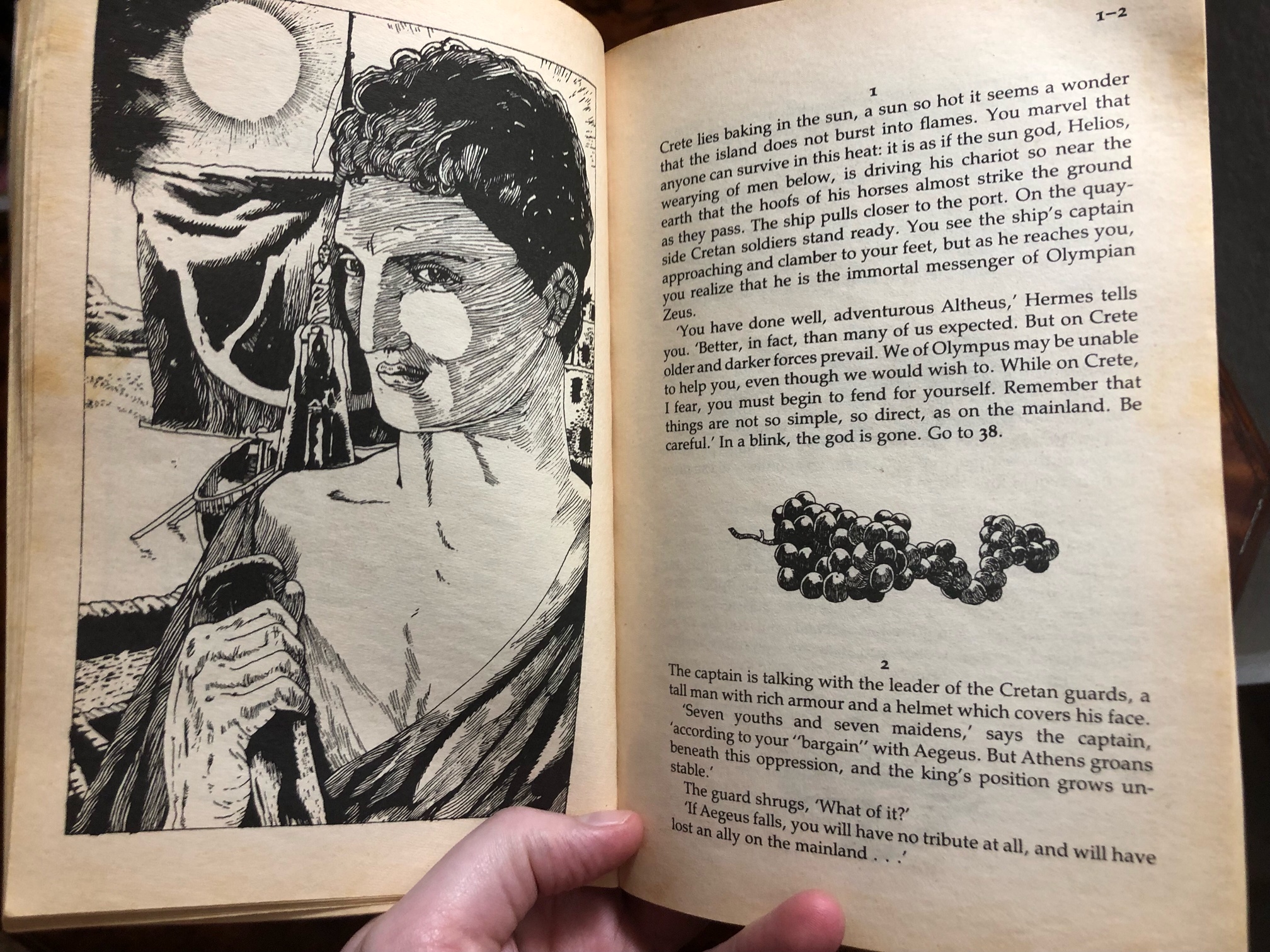
I’ve put off talking about the art long enough. When Dan Woods illustrates locations, objects, and monsters, it’s a sight to behold that really brings the story to life and seeps atmosphere from every page.
His humans look like rejected submissions to a high school art contest. I can’t even figure out their anatomy in half of them. Are these two dudes wrestling? Dancing? Is it one dude splitting into two dudes like an amoeba? Is the woman on the right a fish in disguise?

Whatever criticisms I have for At the Court of King Minos, I think I had a lot more fun than with the first book by virtue of it not revolving around me losing fights (the lack of a chariot race was a big minus, though). Like the first book, the choices are sometimes logical, and sometimes screw you for no reason. The combat is still broken, but there’s a lot less of it here at least. That the plot revolves around navigating political intrigue makes it different from the cross-country exploration of Bloodfeud, so it’s already bringing a lot of variety to the trilogy.
And there are many memorable moments. One dude’s fate is as weird and goofy as it is haunting, as only something from Greek mythology can be. The minotaur is suitably scary when you enter his domain, and he’s definitely the most memorable and built-up bad guy of the series, though Minos himself is no slouch, either. And I still can’t sing enough praises for the immersive ancient Greek setting, a refreshing change after countless Dungeons & Dragons flavored gamebooks.
I still just wish the combat in this series wasn’t such a downer. That might be the biggest thing dragging down Cretan Chronicles. Well, that and the fact that the gods are just a bunch of modern pop culture references. Looking forward to the finale of this trilogy in any case, and I still stay it’s a worthy addition to any gamebook collector’s library, especially if they’re tired of Fighting Fantasy.
Time for bed. Uncle Mac out.

 Uncle Mac's Gamebook Shack