
Without hesitating, you stomp across and grab the miserable Hobbit with your claws.
I’m probably going to ruffle some feathers of Fighting Fantasy fans with my first review of this beloved and long-running series. This is by no means the first FF book I have ever read, but given how highly regarded it is, I decided it would be a good one to really sink my teeth into for the website.
After roughly a dozen readings or so, I think this book should have been called Wanderhalls of Futility.
Fighting Fantasy is one of the most prominent gamebook franchises ever, co-written by pre-Munchkin Steve Jackson of Steve Jackson Games. This series went above and beyond anything Choose Your Own Adventure ever did, by taking CYOA’s interactive storybook approach and adding a Dungeons & Dragons style attribute system, an inventory, and dice combat. The end result is not so much an interactive fiction book as it is a solo RPG adventure, and many gamebook franchises followed in its footsteps.
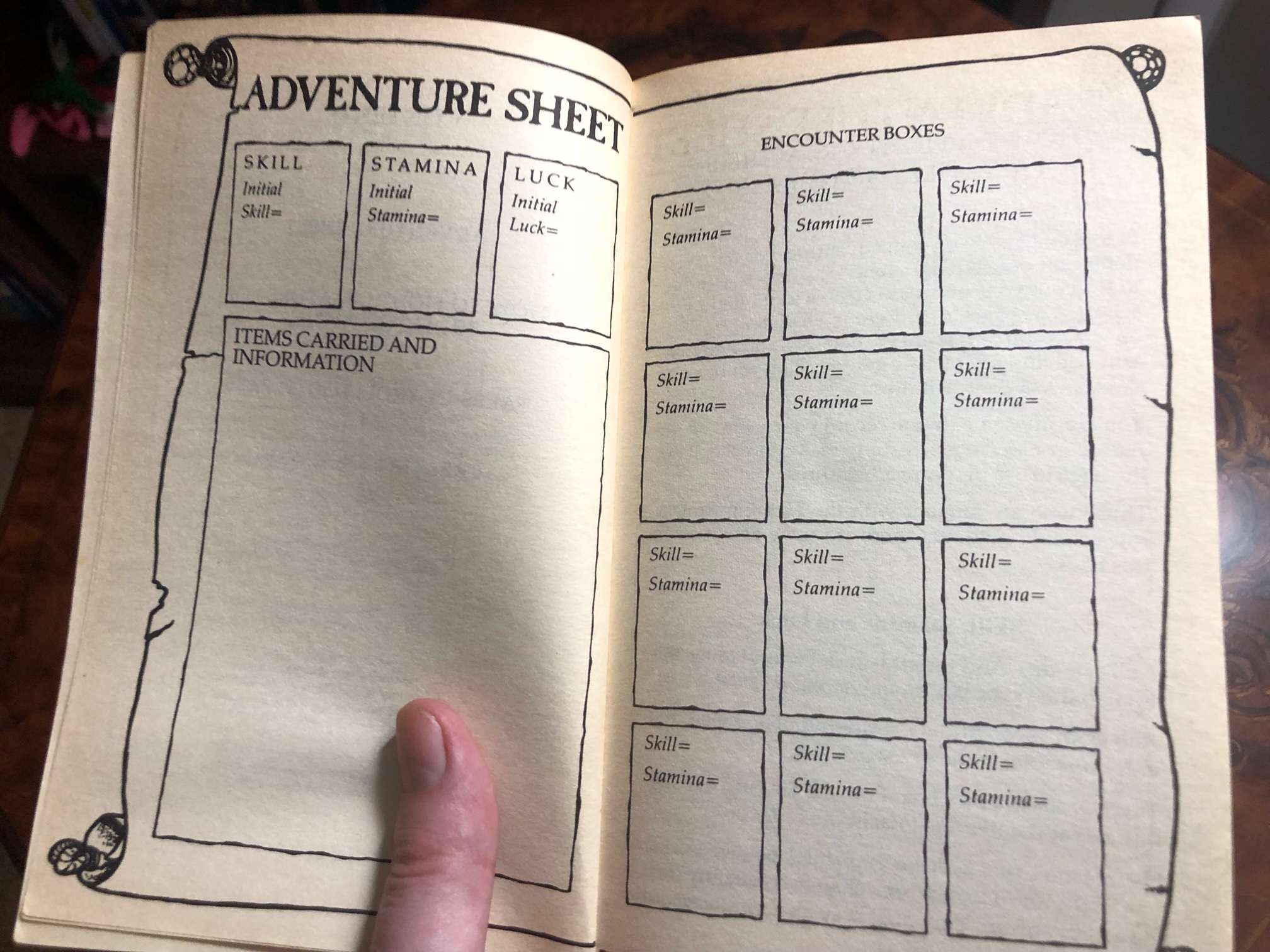
The Fighting Fantasy system boils down to the following. You travel through a fantasy narrative that is broken into paragraphs rather than chapters or pages, and each book consists of hundreds of these paragraphs to create a maze-like narrative with countless possibilities. Before you embark on your quest, you create a character by rolling six-sided dice to determine your Skill, Stamina, and Luck.
Skill refers to your handiness in a fight, and you’d better believe you’re gonna use it a lot. If you roll a poor skill trait, you will probably have a hard time hitting your enemies.
Stamina is basically how much punishment you can take before you die. If you run out of Stamina, the story ends abruptly.
Luck allows you the chance to tip the scales in your favor, at the risk of making things worse. If you hit an enemy with an attack, you can try your luck to see if you do extra damage (or less damage if you botch it). Your Luck is limited, though: each time you “try your luck,” said Luck decreases by 1 after you make the roll. I like this mechanic more than the rudimentary fighting system itself, which ironically feels a bit too luck based in practice.
In addition to these traits, there is usually a special gimmick that varies from book to book. Slaves of the Abyss has a time limit, for example, giving you only so many days to accomplish your mission before doom befalls your allies. House of Hell gives you a “fear meter” that makes you die of fright if it gets too high.
Creature of Havoc‘s gimmick is that you begin the story as a monster. You act on instinct most of the time, can’t understand languages, and can’t resist eating a Hobbit whenever you see one. As you progress through the story, your humanity gradually comes back to you, and you start to act more like a man again. You can also potentially insta-kill your enemies if you roll really well in a fight, which is nice.
It’s an interesting premise, the dumb beast rediscovering his humanity while uncovering the cause of his affliction. And I would love to have uncovered more of that mystery, but several things really got in the way, either related to this particular book, or the series’ design as a whole.

I should mention that the book opens with several pages of backstory about the setting, Troll Tooth Pass, including a full color map on the inside cover. I glossed over this a little, but upon remembering that I’m playing someone who has been turned into a dumb monster with amnesia (and the fact that the final paragraph warns that this information is useless and possibly even inaccurate anyway), I decided to ignore all of it and discover the setting for myself.
At the proper beginning of Creature of Havoc, I awaken as an angry beast man in a cell with a dwarf I can’t understand. I’m given the choice of trying to talk to him, trying to help him, or killing him outright. The book’s first annoying personality trait rears its ugly head here: offering choices that all lead to similar outcomes, as any choice I make leaves the dwarf dead, and two of them leave me injured as well. At least it makes sense this early on. As a temperamental and animalistic beast, I can’t really accomplish non-monster behavior very well yet, such as reading languages or refraining from mauling anything shorter than seven feet tall.
But from here begins an endless string of paragraphs detailing my tour of the dungeon. After investigating the Dwarf’s corpse (whether I want to or not), I go through a corridor and find a couple doors. I choose a direction, and am given another description of a hallway with directions to choose. Three turns and doorways later I come to a dead end and have to backtrack and choose another direction.
This goes on for what feels like hours.

Many, many paragraphs of this story simply describe my travels through every inch of the dungeon without anything noteworthy happening. Aggravating things further is the fact that I have to roll a die to see what choice I make, because I’m acting on instinct, so I don’t actually get a choice in anything at this stage in the story. I guess I’m intended to map out the dungeon as I explore, but I’m discouraged from this by the fact that when something does finally happen, it’s almost always disastrous. I investigate a shiny pit in the floor, and it turns out to be a giant hornet, which kills me in one or two stings. Game Over.
Or I barge impulsively into the cell of a monster with better fighting skills than me, and I watch my Stamina get whittled down to nothing while I repeatedly fail to hit the monster. Game Over.
Or I randomly stumble into one of countless bottomless pits and die. Game Over.
Or I take a wrong turn into an endless, inescapable cycle of dead-ends, where the only exit involves me losing my temper and causing a cave-in that traps me forever. Game Over.
OR my personal favorite, I encounter a man who actually speaks a language I understand, giving me the sense that I finally, FINALLY made some progress in the story, so I approach the stranger to unlock the next chapter of the narrative, and he turns out to be a mimic who devours me instantly. Game Over.
This is all in the beginning dungeon, too. I haven’t even mentioned the crap that I dealt with when I found my way out, like getting corralled into a forest goblin booby trap where the many choices I was offered simply resulted in different ways to die. Game Over.
Even when I cheated and began at a random paragraph just to see where the story might lead if I toughed out the insufferable early sections, I went in circles, and then died.
Books this lengthy and involving shouldn’t have random instant-deaths, nor allow me to perish to an unlucky die roll. It’s frustrating when it happens repeatedly in the early attempts at the book. It’s even worse when you finally make progress and travel a good distance through the narrative, only to die abruptly to something stupid.
That’s not to say there’s nothing interesting in Creature of Havoc though. During one reading I ate about five Hobbits and really raised hell in the dungeon before meeting my just desserts at the bottom of an insta-death pit trap. That was fun while it lasted.

Eventually I broke down and researched the book online to see what I could possibly be doing wrong. Maybe the book wasn’t designed by sadists who don’t playtest their work. Maybe I’m just an idiot. That has to be it. Right?
Apparently this book follows the “one true path” design philosophy, where you have to puzzle out the correct path through the story to get all the items you need and avoid all the deaths. In a 90-page Twistaplot, I can see this working just fine, even though it’s a practice I’m trying to avoid with my own work (hence why I’m releasing a second edition of Holiday in Castle Quarantine, as the first edition used a similar philosophy).
In a 460-chapter epic like Creature of Havoc, this design philosophy is unacceptable, no matter how immersive the setting may be. It requires a hideous number of attempts (and an absurd number of character re-rolls) to stumble into the correct way to the proper ending. This is especially aggravated by the early stages when you’re a monster who’s too dumb to act logically or competently, even if this does make for a hilariously bungling protagonist at times.
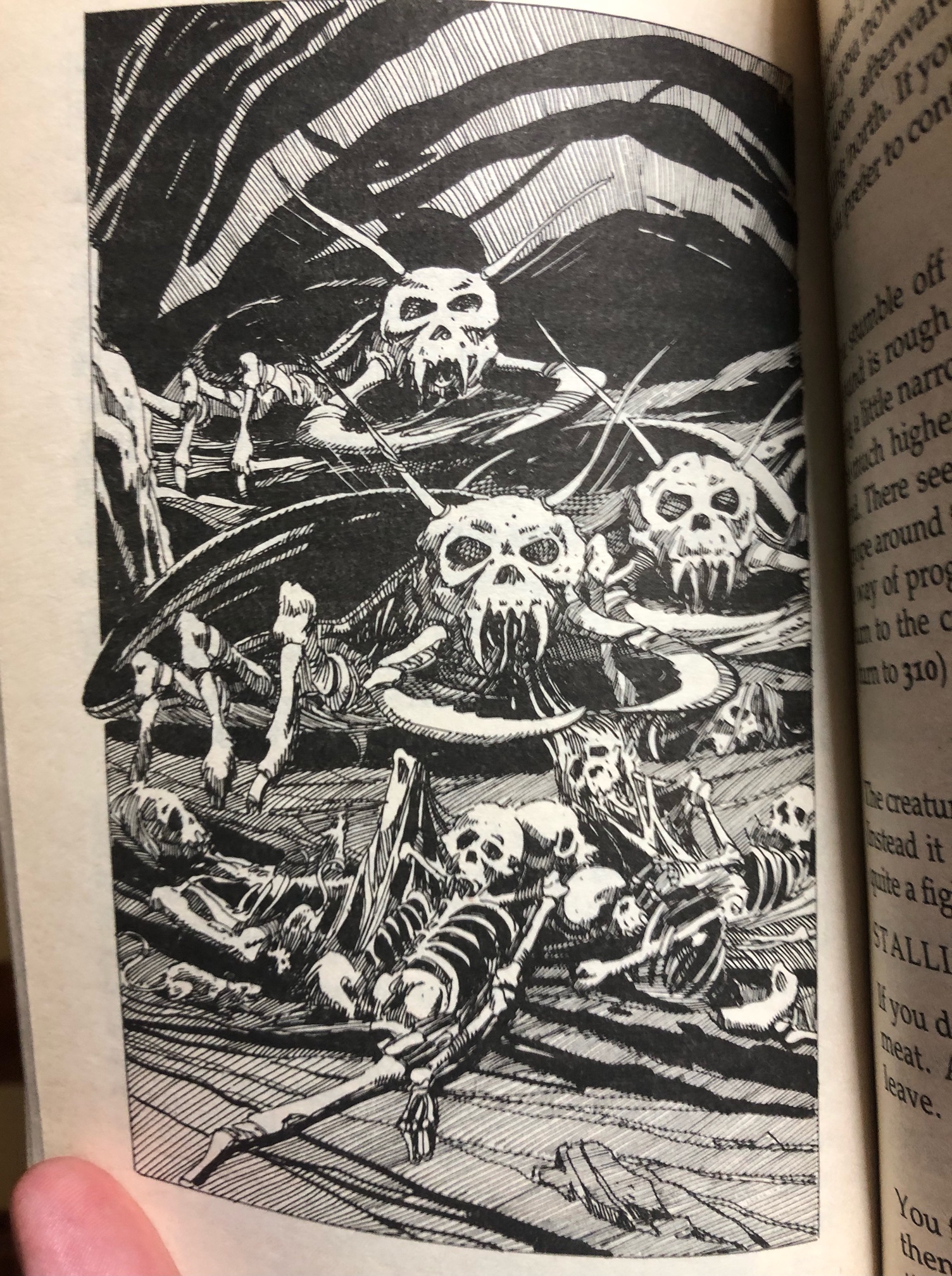


There is no denying that the artwork is phenomenal, though. Every creature depicted is fearsome and gross, and the rooms and landscapes almost feel real. The art style evokes classic adventure comic books, and it’s no surprise that artist Alan Langford is a professional conjurer of fantasy and wildlife illustrations. His more fearsome monsters are a horror to behold, especially that grinning fiery-eyed ghoul. Yeesh.
There’s a great fantasy story buried in Creature of Havoc, and I really wanted to uncover its secrets. I just can’t get past the obnoxious progression and overall design. As annoying as Cretan Chronicles is, at least that series makes me feel like I’m making progress before I die a useless death or get shafted out of my Honor points. This book just feels like a waste of time and effort, and after so many tries it just wasn’t worth it to me. You may feel differently about it.
Ultimately these “solo RPG” type gamebooks aren’t my cup of tea. It’s a sub-genre that requires homework and a large time investment, and oftentimes I just want something I can pick up and read, and preferably something that won’t kill me with an unlucky die roll. I really have to be in the mood to hunker down with something as heavy as Fighting Fantasy and its cousins.
I haven’t written off Fighting Fantasy altogether, though, and I’ll revisit the series at a later date. But I’ve been reading this book off and on for a couple weeks now, and I need a break.
Time for bed. Uncle Mac out.

 Uncle Mac's Gamebook Shack