
You’ve really made a mess of things—especially yourself.
We’re back from a short hiatus with a new gamebook to chuckle about, this time by the legend himself, R L Stine! If you’ve read my previous blog posts, you know that I’m anything but a Stine fan: even when I was a kid, I felt that his writing was silly, fourth-wall breaking, and generally read like it was published in first draft status to keep up with his “quantity over quality” quota, whether I’m reading his later efforts, or an older one like this. Golden Sword of Dragonwalk reads an awful lot like proto-Goosebumps fare, and includes all the issues I’ve already mentioned.
There are a few diamonds in the rough, though. I’m not totally unfair even when reading an author I don’t care for.
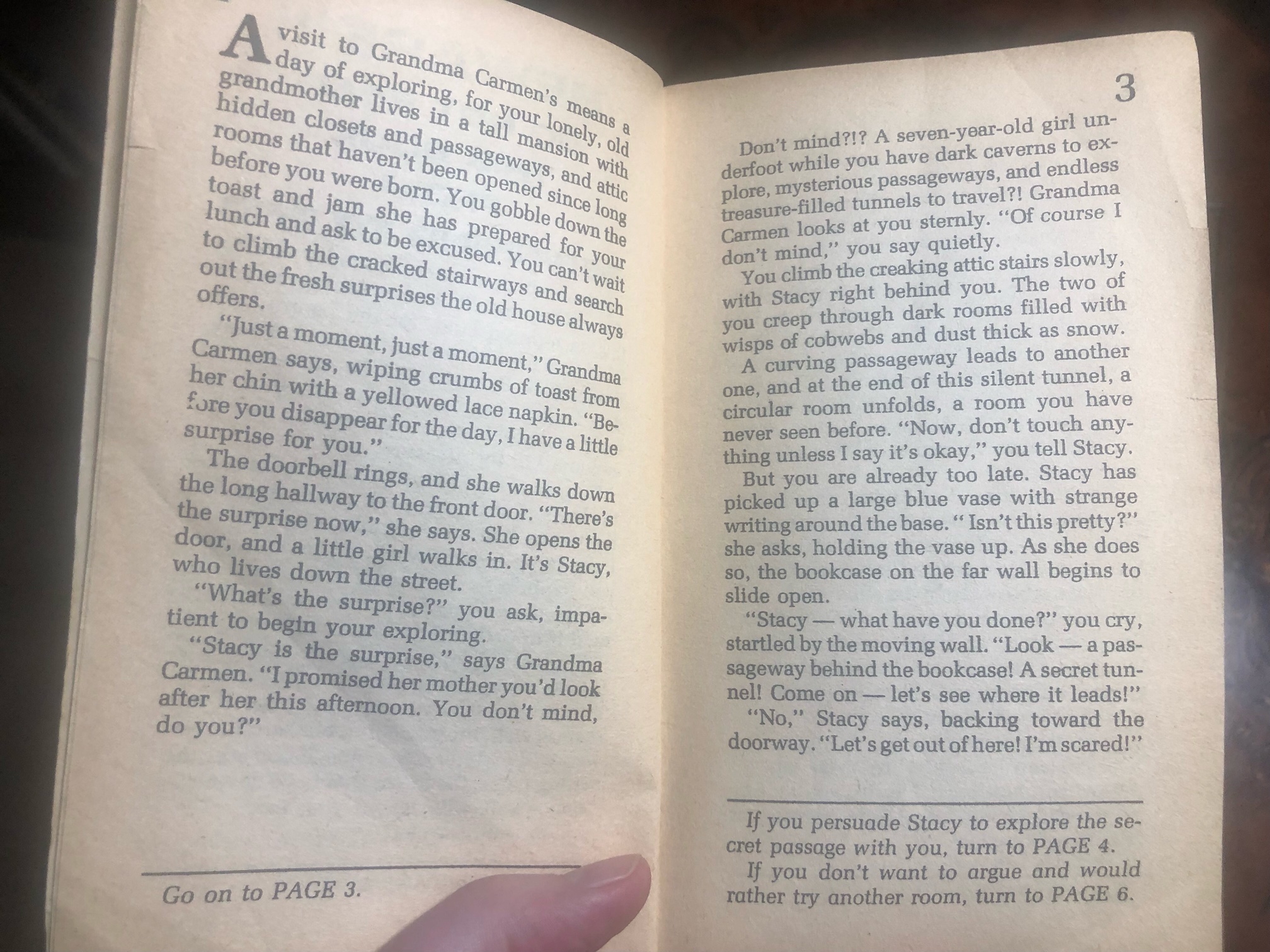
Golden Sword of Dragonwalk is the fourth volume of the infamous Twistaplot series, all of which have the Stine flavor in some form or another. Here we are a young boy who is excited to once again explore his Grandma Carmen’s spooky old property during a visit, only to learn we have been volunteered by Grams to babysit Stacy, a young girl who lives up the street. I actually like the opening to this one because the way Stacy is introduced did get a chuckle out of me.
So we explore the house anyway with the annoying Stacy in tow, and get sucked into a medieval fantasy world being ravaged by dragons under the control of Ravenhurst the sorcerer (see, that’s a good villain name, Prisoner of the Ant People!)
Calling the story “Golden Sword of Dragonwalk” is apt, because the story does indeed take place in the fantasy realm of Dragonwalk, and the main character is indeed the Golden Sword. Because you solve pretty much all your problems with it. Whether it’s a man-eating tree or an ever-growing fire-emitting salamander or a flock of killer owls or even a dragon of any size, the solution usually involves stabbing things with the titular sword.
Your choices are often luck based, so beating the book is a matter of trial and error. There are several moments where your choice is based on picking a number between 1 and 9, or whether the current date is an odd or even number. Most of the options on offer don’t use gimmicks like this, but still have no indication whether they’re the right choice or not. You get snatched up by a giant maneating bird. You can jump free and risk falling to your death, or ride it out and risk getting eaten. Which one’s the right choice? No idea! No logic is used in any of your choices, so you have no idea how things will turn out until it’s too late.
Where the book does get interesting, though, is the three companions you meet: Elkar the warrior, Chalidor the mage, and Bendux the banker (the guy we always chose in Oregon Trail, let’s be real here). Early in the story when you meet these guys, you only get to take one of them with you, and your choice of company will drastically alter certain events. This part of the book is actually fun, and it would’ve been nice to see the story hinge on this more.
Despite his cool name, Ravenhurst is a pathetic villain, no matter which companion you face him with. I won’t spoil the endings, but they’re all pretty lame, end things on a comedic note, and leave you wondering why everyone was so afraid of this guy in the first place.
The bad endings are the pits, too. Just about every one of them breaks the fourth wall to lighten the mood when you fall to your death and splat against the rocks below. In keeping with the Stine manifesto, “The reader shalt not feel.” Maybe I’m the crazy one to think that if you write adventure, there should be peril and pathos, and if you write horror, there should be scares. It’s like making candy without the sugar–why bother?

The artwork found in the gamebook genre is a mixed bag. Sometimes it’s stellar, like the Be an Interplanetary Spy series, which is heavy on the pulp comic strip vibe. Others are rough and sketchy, like Which Way books, rough around the edges but still sometimes managing to convey a sense of atmosphere. Some are a mixed bag in themselves, like Choose Your Own Adventure, ranging from “K-8 school talent show” to “former Marvel comics artist.”
The art in Dragonwalk is…weird. I might even say surreal. The picture above looks like I’m disappointed to be getting a dope golden dragon-slayer sword. Meanwhile the tree looks mad that he didn’t get it for himself. Or maybe he’s as baffled as I am that anyone would be okay with assigning a “save the world” quest to a dumb 12-year-old.

This illustration says it all, though. It would’ve made Dragonwalk a lot more interesting if everything was as distorted and nightmarish as that image of the weirdly-proportioned warrior swinging a Keebler elf by the ankle.
So yes, I’m once again a grown man criticizing books meant for young readers. But my thoughts on these books haven’t changed since I was twelve. Golden Sword of Dragonwalk falls drastically short of being a shining example of the genre, but it does have a few interesting things in it to make it worth reading a couple times anyway. Just wish Stine took his stories as seriously as his readers.
Time for bed. Uncle Mac out.

 Uncle Mac's Gamebook Shack